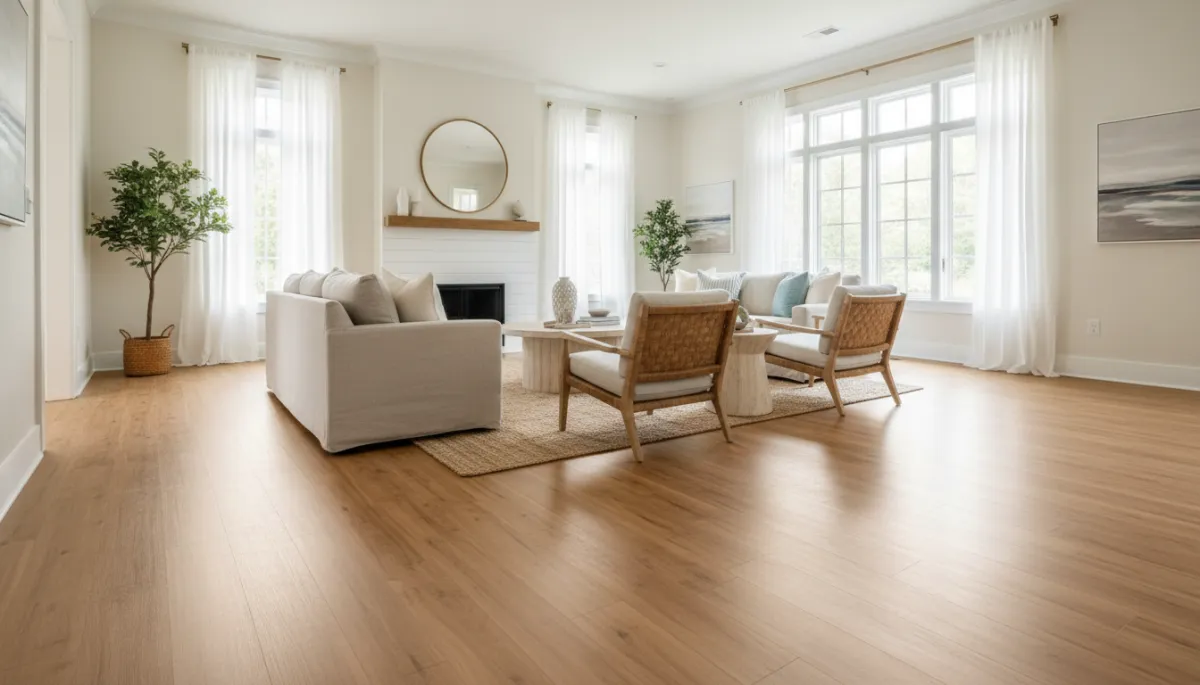
Best Flooring for Humid Climates: What Hampton Roads Homeowners Should Know
Living along the Virginia coast comes with a lot of advantages — waterfront scenery, mild winters, and a strong sense of community throughout the Hampton Roads region. It also means contending with year-round humidity that affects nearly every aspect of home maintenance, including the floors beneath your feet.
At Oak Flooring, we install hardwood, vinyl plank, and laminate floors for homeowners throughout Norfolk, Virginia Beach, Chesapeake, Portsmouth, Hampton, Newport News, and Suffolk. One of the most consistent questions we hear during free estimates is straightforward: What is the best flooring for a humid climate?
This guide gives you a clear, honest answer based on how each flooring type actually performs in coastal Virginia conditions.
Why Humidity Matters for Your Floor
The Hampton Roads area sits at the confluence of the Chesapeake Bay and the Atlantic Ocean. Relative humidity levels here regularly reach and exceed 70 percent during summer months, and the moisture load on homes remains elevated well into fall. Your floors are in constant contact with that environment.
Flooring materials respond to humidity through moisture absorption. When a floor material absorbs airborne moisture, it expands. When the air dries out — as it does in winter when heating systems run — the material contracts. Repeated cycles of expansion and contraction cause gaps between planks, cupping along plank edges, buckling in severe cases, and adhesive bond failures in glue-down installations.
The technical term for a floor's ability to resist these changes is dimensional stability. The more dimensionally stable a product is, the better it performs in a humid climate like Hampton Roads.
Luxury Vinyl Plank: The Most Humidity-Resistant Option

Luxury vinyl plank, or LVP, is the most humidity-resistant flooring category currently available for residential installations. The core of an LVP plank is composed of polyvinyl chloride (PVC) — a synthetic polymer that does not absorb water. As a result, LVP does not expand, contract, cup, or buckle in response to changes in ambient humidity.
For Hampton Roads homeowners, this characteristic makes LVP particularly well-suited for:
- Ground-level rooms over concrete slabs, where moisture migrates upward from the ground
- Kitchens and laundry rooms, where liquid spills are frequent
- Finished basements and below-grade spaces
- Sunrooms and spaces adjacent to exterior entries where conditioned and unconditioned air meet
LVP also offers practical advantages beyond humidity resistance: scratch resistance, easy maintenance, comfort underfoot with attached underlayment, and dozens of realistic wood and stone patterns. These qualities have made it one of the most requested products in our service area.
One important consideration: LVP products are not all built alike. Wear layer thickness (measured in mils), core rigidity, and locking system quality vary considerably between product lines. An experienced local installer can identify the right product for your specific subfloor conditions, foot traffic levels, and budget.
Hardwood Flooring: Beautiful and Durable, With Conditions

Solid hardwood flooring carries a timeless appeal and a track record of durability that few other products can match. It is also a hygroscopic material — it naturally absorbs and releases moisture as the surrounding air changes. In a coastal Virginia home, that means the floor will expand slightly each summer and contract each winter as your HVAC system removes moisture from the indoor air.
This movement is manageable, not disqualifying. Hardwood floors have been installed successfully in humid regions throughout the American South for generations. The key is doing it correctly:
- Acclimation: The flooring product must be stored in the installation environment for a minimum of 48 to 72 hours before installation begins, allowing the wood to reach equilibrium with the home's ambient moisture content.
- Expansion gaps: Proper gaps at all walls, transitions, and fixed objects allow the floor to move without buckling or cracking.
- Indoor climate control: A functioning HVAC system should maintain indoor relative humidity between approximately 35 and 55 percent year-round. Homes without consistent climate control are not good candidates for solid hardwood.
- Subfloor suitability: Solid hardwood should not be installed directly over concrete slabs or in below-grade rooms. It performs best over wood subfloors on above-grade and main-level installations.
Engineered hardwood — a genuine hardwood veneer bonded to a dimensionally stable plywood or high-density fiberboard core — offers meaningfully better humidity resistance than solid hardwood while preserving the appearance and feel of natural wood. For Norfolk homeowners who want the warmth of hardwood but want a larger margin of safety in a humid environment, engineered hardwood is often the more practical choice. It can also be installed over concrete with appropriate moisture mitigation, expanding the rooms where it is viable.
Laminate Flooring: A Reliable Option in the Right Rooms
Laminate flooring is a popular choice for homeowners who want the appearance of wood or stone at a more accessible price. The core layer of most laminate products is high-density fiberboard (HDF), a wood-based composite that is more sensitive to moisture than LVP's synthetic core.
Standard laminate should not be used in rooms with chronic moisture exposure — laundry rooms, bathrooms, or basement spaces in older homes with known moisture issues. In those environments, the core can swell at the seams over time, causing the floor surface to separate or lift.
That said, laminate technology has advanced. Many current product lines include water-resistant surface coatings and tighter locking systems that prevent minor spills from penetrating the core. Some manufacturers now produce genuinely waterproof laminate with sealed edges designed for elevated-moisture applications.
For dry living areas — bedrooms, formal dining rooms, and home offices — quality laminate remains an excellent value in Hampton Roads homes. The key is matching the product to the room, not assuming all rooms in a coastal home have the same moisture profile.
The Subfloor: The Step Most Homeowners Overlook

No flooring product — regardless of its humidity rating — performs well when the subfloor beneath it is compromised. In Hampton Roads, subfloor moisture is a real concern, particularly in homes with concrete slabs poured directly on grade.
Before any installation, a responsible flooring contractor will:
- Test the concrete slab for moisture emission using a calcium chloride test or in-situ relative humidity probe
- Apply a vapor barrier or moisture-control membrane where readings exceed acceptable thresholds
- Level the subfloor to eliminate low spots where standing water or condensation can accumulate
- Confirm that the existing subfloor is structurally sound and free of soft spots, rot, or damage
Skipping these steps to reduce cost or shorten a project timeline is one of the most common reasons flooring installations fail prematurely in coastal Virginia. At Oak Flooring, moisture testing and subfloor assessment are part of every installation scope — not optional add-ons.
Room-by-Room Recommendations for Hampton Roads Homes
| Room | Best Option | Notes |
|---|---|---|
| Living Room / Family Room | LVP, Engineered Hardwood, or Laminate | All three perform well with consistent HVAC |
| Kitchen | LVP | Best resistance to spills and humidity ingress |
| Bedrooms | LVP, Solid Hardwood, or Laminate | Low moisture exposure; solid hardwood works with climate control |
| Laundry Room / Mudroom | LVP | Waterproof core essential |
| Finished Basement | LVP | Solid hardwood not recommended; LVP floats freely over slab |
| Sunroom / Enclosed Porch | LVP | Temperature and humidity swings make vinyl the safest choice |
Frequently Asked Questions
What is the most humidity-resistant flooring for a home in Hampton Roads?
Luxury vinyl plank with a waterproof core is the most humidity-resistant flooring option currently available for residential use. Its synthetic PVC core does not absorb moisture, making it well-suited for the elevated humidity conditions throughout the Norfolk, Virginia Beach, and Chesapeake areas.
Can hardwood floors be installed in Norfolk, VA?
Yes. Solid and engineered hardwood floors are regularly installed in Norfolk and across Hampton Roads with good long-term results, provided the installation is done correctly — proper acclimation, acceptable subfloor moisture levels, adequate expansion gaps, and a climate-controlled living environment. Engineered hardwood offers greater stability and is generally the safer choice in high-humidity coastal homes.
Is laminate flooring a good choice for Virginia Beach or Chesapeake?
Standard laminate performs well in dry rooms of Hampton Roads homes — bedrooms, living areas, and home offices. It is not recommended for kitchens, laundry rooms, or basement spaces with elevated moisture exposure. Water-resistant and waterproof laminate products offer improved protection but generally still trail LVP in overall moisture performance.
How do I know if my subfloor has a moisture problem?
Moisture testing is the only reliable way to answer this question. For concrete slabs, the industry-standard methods include calcium chloride emission tests and in-situ relative humidity probes inserted into the slab. Oak Flooring conducts moisture assessments as part of every pre-installation process.
Does Oak Flooring serve areas outside of Norfolk?
Yes. Oak Flooring provides flooring installation services throughout Hampton Roads, including Virginia Beach, Chesapeake, Portsmouth, Hampton, Newport News, and Suffolk.
Schedule Your Free Estimate
Choosing the right floor for a humid coastal climate is a decision that deserves a conversation — not a guess. Oak Flooring provides free in-home estimates throughout Hampton Roads with no obligation. During your estimate, we assess your subfloor, discuss your household's lifestyle and budget, and recommend the product best suited to your specific space.
Call us at +1 (757) 775-0280, Monday through Saturday, 8 a.m. to 6 p.m., or book your estimate online. Please ensure someone 18 or older is home at the time of the visit. Estimates are free and typically take about 30 minutes.
